Showing posts with label supply. Show all posts
Showing posts with label supply. Show all posts
Friday, April 12, 2013
Power Supply with tube
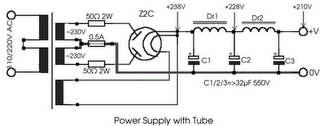
Power supply with Z2C tubes are designed specifically to provide power supply voltage to the EL-34 tube amplifier push-pull in the previous article. Power supply with Z2C tube to tube power amplifier is made with a tube rectifier Z2C. Just as the power supply for power amplifier tube earlier, power supply also uses a filter 3 levels with kapsitor electrolyte. Circuit power supply with tube rectifier Z2C can give +210 VDC output voltage. A complete range of power supply for power amplifier tube can be seen in thethe following figure .
 |
| Power Supply with tube |
Z2C on the rectifier tube in power supply with tube above require a supply voltage for the filaments taken from the other side of the transformer secondary. Power supply with Z2C tube is a power supply that dapt used as a substitute power supply for power amplifier tubes .

Friday, March 29, 2013
AC Power Supply Low Voltage
This is an AC power supply circuit with low voltage output (step down transformer converter). Notes! This project involves the use of dangerous voltages. You must make sure all high-voltage (120 volt household power) conductors are safely insulated from accidental contact. No bare wires should be seen anywhere on the “primary” side of the transformer circuit. Be sure to solder all wire connections so that they’re secure, and use real electrical tape (not duct tape, scotch tape, packing tape, or any other kind!) to insulate your soldered connections. If you wish to enclose the transformer inside of a box, you may use an electrical “junction” box, obtained from a hardware store or electrical supply house. If the enclosure used is metal rather than plastic, a three-prong plug should be used, with the “ground” prong (the longest one on the plug) connected directly to the metal case for maximum safety.


Before plugging the plug into a wall socket, do a safety check with an ohmmeter. With the line switch in the “on” position, measure resistance between plug prong and the transformer case. There should be infinite (maximum) resistance. If the meter registers continuity (some resistance value less than infinity), then you have a “short” between one of the power conductors and the case, which is dangerous!
Next, check the transformer windings themselves for continuity. With the line switch in the “on” position, there should be a small amount of resistance between the two plug prongs. When the switch is turned “off,” the resistance indication should increase to infinity (open circuit — no continuity). Measurement the resistance between pairs of wires is on the secondary side. These secondary windings should register much lower resistances than the primary. Why is this?
Plug the cord into a wall socket and turn the switch on. You should be able to measure AC voltage at the secondary side of the transformer, between pairs of terminals. Between two of these terminals, you should measure about 12 volts. Between either of these two terminals and the third terminal, you should measure half that. This third wire is the “center-tap” wire of the secondary winding.
Subscribe to:
Comments (Atom)